

SBR filing (deponeren) means submitting the annual accounts (jaarrekening) digitally and in a structured format to the Kamer van Koophandel (KVK) via Standard Business Reporting. Micro and small enterprises have been subject to this obligation since financial year 2016, medium-sized legal entities since financial year 2017. Since the amendment of the Besluit elektronische deponering handelsregister of 18 December 2024, large legal entities are also required to file digitally, for financial years beginning on or after 1 January 2025. Since financial year 2024 you choose between the classic SBR format (XBRL instance) and the European format (iXBRL); anyone reporting under IFRS or falling within the scope of the CSRD must use iXBRL.
Key facts
Who: legal entities with a publication obligation under Title 9 of Book 2 of the Dutch Civil Code (BW2 Titel 9), such as bv's, nv's, cooperatives and mutual insurance associations. Sole proprietorships do not have to file. Listed issuing institutions (Article 5:25o Wft) file their annual reporting with the AFM and are exempt from SBR filing with KVK.
Legal basis: Article 2:394 BW (disclosure obligation), implemented through the Besluit elektronische deponering handelsregister and the Regulatory Technical Standard (RTS) of the SBR Handelsregister domain.
Deadline: file within eight days after adoption (vaststelling) and no later than twelve months after the end of the financial year (Article 2:394(1) and (3) BW).
Format: from financial year 2024, a choice between an XBRL instance and iXBRL (XHTML). iXBRL is mandatory for reporting under IFRS and for legal entities within the scope of the CSRD.
Infrastructure: filing is done automatically via Digipoort (managed by Logius) or manually via KVK's Zelf Deponeren portal. Logius manages the Dutch Taxonomy (Nederlandse Taxonomie, NT); the documentation lives on sbr-nl.nl.
Auditor's report: medium-sized and large legal entities file the audit opinion (controleverklaring) along with the accounts, digitally signed by the auditor and in the same format as the annual accounts.
What is SBR (Standard Business Reporting)?
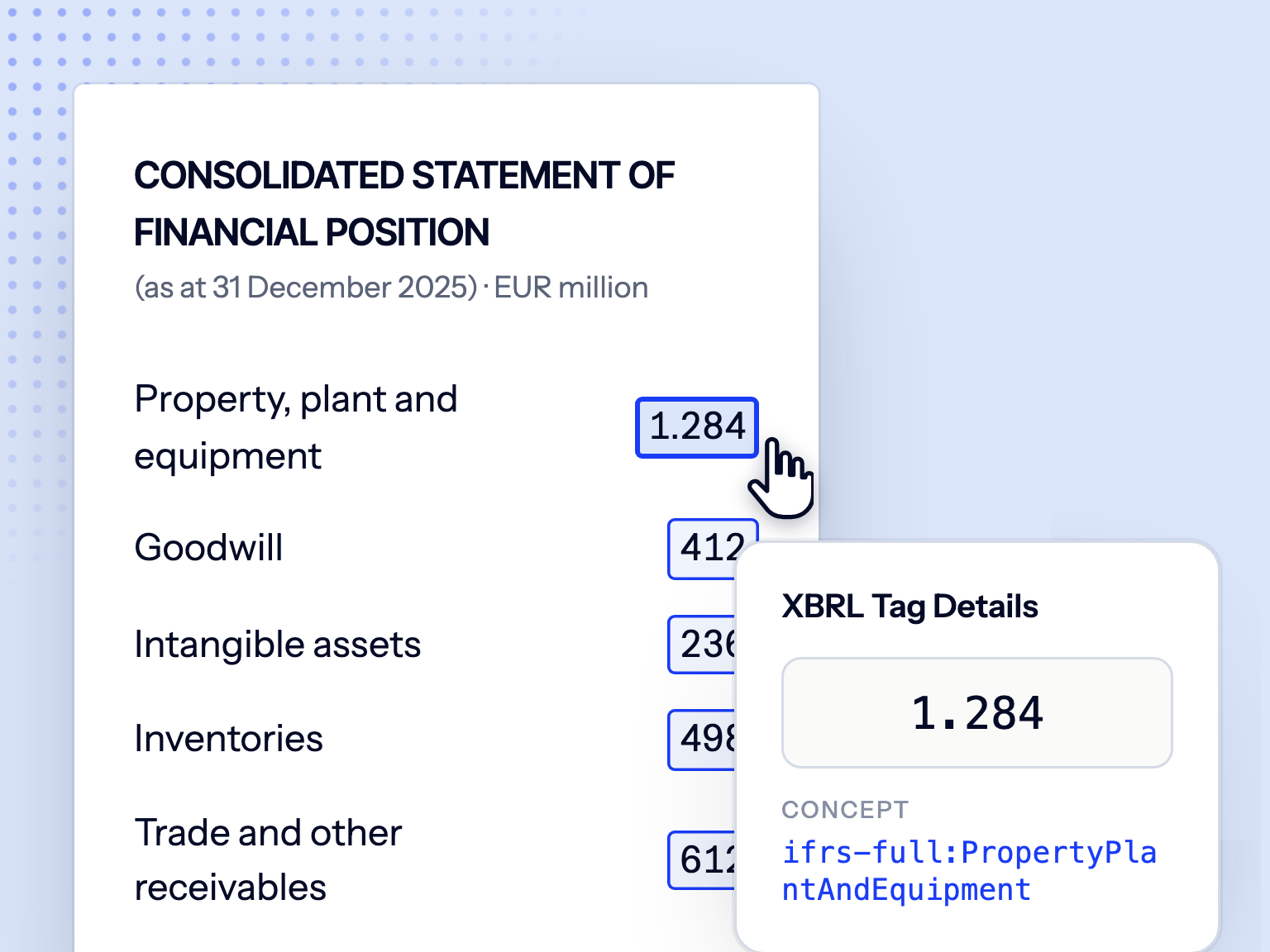
Standard Business Reporting is the Dutch framework of agreements for standardized digital information exchange with government agencies, including KVK and the Belastingdienst (tax authority). Its core is a common language: financial concepts such as 'net turnover', 'balance sheet total' and 'average number of employees' are unambiguously defined in the Nederlandse Taxonomie (NT), a structured catalogue of concepts. The values from the annual accounts are linked to those taxonomy concepts: so-called tagging.
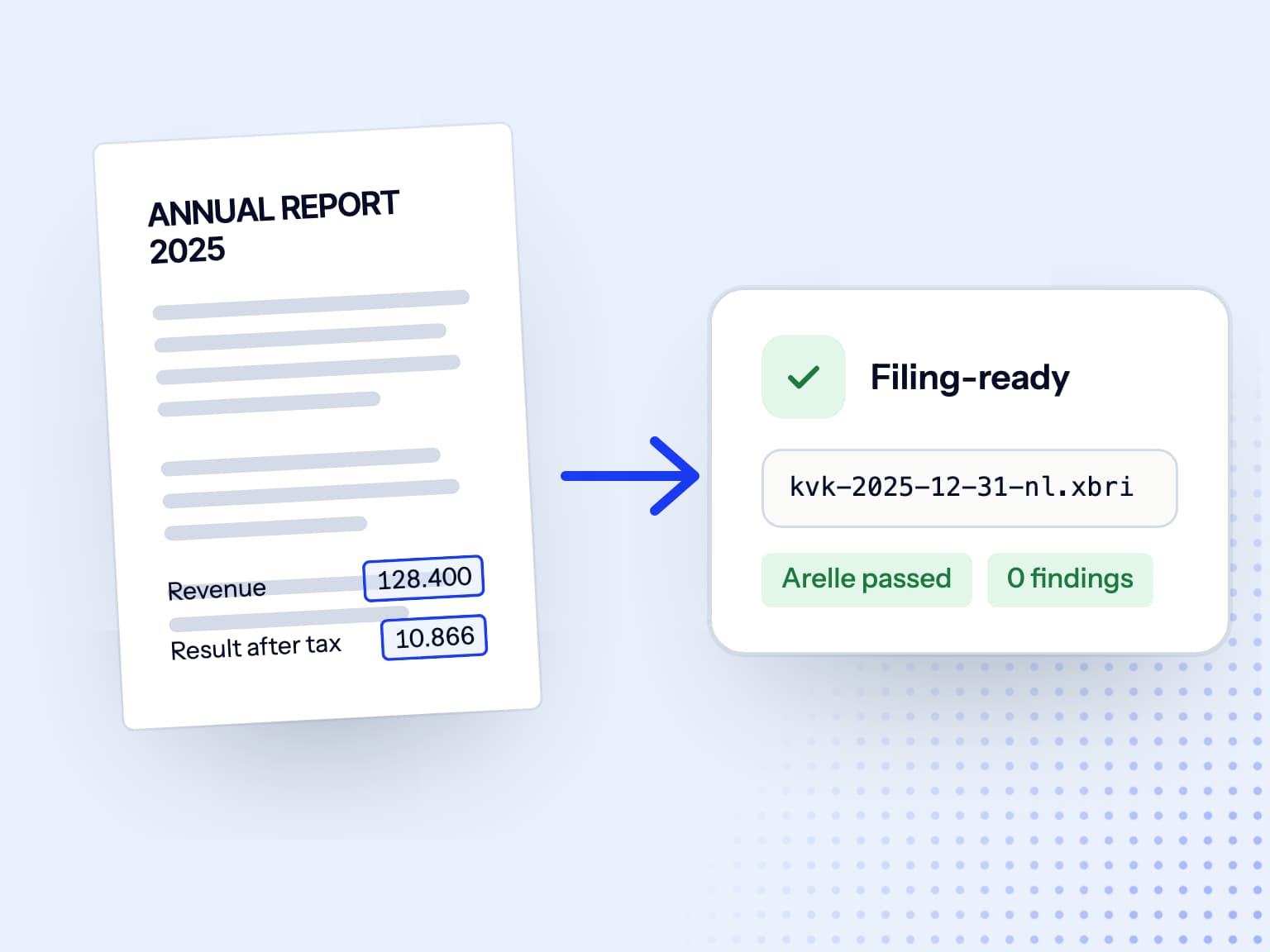
The result is an XBRL instance document or an iXBRL file. Both contain machine-readable tags, so KVK can process the data automatically. With iXBRL (Inline XBRL) the tags are embedded in a readable XHTML document: the auditor, management and KVK all see the same page, while the structured data can be extracted from it automatically. Also read our explanation of the difference between XBRL and iXBRL.
Submission runs through financial software or an intermediary (automated via Digipoort) or through KVK's upload portal. On receipt, KVK performs technical validations, among other things against the SBR Filing Rules. After successful processing, the annual accounts are publicly available to everyone in the Handelsregister (trade register).
How does SBR filing work, step by step?
The process consists of three phases.
1. Tagging based on the Nederlandse Taxonomie. The figures from the annual accounts are mapped to the correct taxonomy concepts. This requires knowledge of the taxonomy structure and of the reporting rules (Dutch GAAP/RJ or IFRS). Mapping errors lead to validation failures at submission or to an incorrect representation in the Handelsregister. If you choose iXBRL, an entity-specific extension taxonomy is part of the package: a small taxonomy set that describes the structure of your annual accounts.
2. Generating the filing file. Depending on the chosen format, this produces an XBRL instance or an iXBRL Report Package: a package containing the XHTML document and the extension taxonomy, which under the RTS may be at most 100 MB. For medium-sized and large legal entities, the auditor's digitally signed audit opinion is added to the package.
3. Submitting to KVK. This can be done automatically via Digipoort or manually via KVK's Zelf Deponeren portal. Micro and small enterprises can also prepare their annual accounts in that portal; medium-sized and large legal entities upload the already adopted annual accounts there, for medium-sized together with the audit opinion and the auditor's signature. Only one adopted annual reporting can be filed per financial year, so check the file before sending.
Deadlines: from preparation to the final filing date
The filing deadline follows from three steps in Book 2 of the Dutch Civil Code. For a bv with a financial year equal to calendar year 2025, the timeline looks like this:
Step | Deadline | Financial year 2025: at the latest |
|---|---|---|
Preparation (opmaken) by the board | 5 months after the end of the financial year | 31 May 2026 |
Extension of the preparation period (general meeting, special circumstances) | up to 5 additional months | 31 October 2026 |
Adoption (vaststellen) by the general meeting | within 2 months after preparation | 31 December 2026 |
Filing with KVK | within 8 days after adoption | no later than 31 December 2026 |
The absolute limit is twelve months after the end of the financial year. Without an extension of the preparation period, the final filing date for a calendar-year financial year is in fact already 8 August: five months to prepare, two months to adopt and eight days to file. If the annual accounts have still not been adopted at the end of the twelve-month period, you file the prepared but not yet adopted annual accounts, stating that fact (Article 2:394(2) BW). Watch out for the common mistake at bv's where all shareholders are also directors: signing by the board then usually counts as adoption immediately, so the two-month adoption period does not apply. The final filing date then becomes 8 November (ten months plus eight days) instead of 31 December. Check the articles of association to see whether this automatic adoption has been excluded.
Filing late or not at all is a criminal offence under Dutch economic-offences law and can result in a fine or prosecution. The biggest risk is director liability: if the legal entity goes bankrupt while the annual accounts were not filed on time, the director can be held personally liable.
By size category: obligations and format
Which regime applies depends on the size criteria: balance sheet total, net turnover and average number of employees. You fall into a regime if you meet at least two of the three criteria on two consecutive balance sheet dates. The threshold amounts were raised by approximately 25 percent for financial years beginning on or after 1 January 2024, with optional application to financial year 2023 (Staatsblad 2024, 52). See our overview of the 2024 size criteria for the classification in detail.
Regime | Balance sheet total | Net turnover | Employees |
|---|---|---|---|
Micro (art. 2:395a BW) | ≤ € 450,000 | ≤ € 900,000 | < 10 |
Small (art. 2:396 BW) | ≤ € 7.5 million | ≤ € 15 million | < 50 |
Medium-sized (art. 2:397 BW) | ≤ € 25 million | ≤ € 50 million | < 250 |
Large | > € 25 million | > € 50 million | ≥ 250 |
The size category determines since when digital filing is mandatory, which format you may use and whether an audit opinion is required:
Regime | SBR mandatory since | Format | Audit opinion |
|---|---|---|---|
Micro | Financial year 2016 | XBRL or iXBRL (choice from financial year 2024) | No |
Small | Financial year 2016 | XBRL or iXBRL (choice from financial year 2024) | No |
Medium-sized | Financial year 2017 | XBRL or iXBRL (choice from financial year 2024) | Yes, via SBR Assurance |
Large | Financial year 2025 | XBRL or iXBRL (choice from financial year 2024) | Yes, via SBR Assurance |
IFRS or CSRD reporting | Financial year 2025 (IFRS annual accounts count as large) | iXBRL mandatory | Depending on the audit requirement |
Large legal entities and their medium-sized subsidiaries were still allowed to file on paper or in PDF up to and including financial year 2024; that exception lapsed as of financial year 2025. Only listed issuing institutions covered by Article 5:25o Wft remain exempt: they file their annual reporting with the AFM.
SBR Assurance: the audit opinion in the digital process
Medium-sized and large legal entities must include an audit opinion (controleverklaring) with the annual accounts; when exactly that audit requirement applies is explained in our article on the auditor's report for the annual accounts. With SBR filing, the opinion travels along digitally via SBR Assurance: the auditor signs electronically with a qualified personal professional certificate, and the opinion is filed in the same format as the annual accounts.
NBA Alert 50 (June 2025) clarifies the accountant's role with the SBR Report Package. If audited annual accounts are technically converted to an SBR Report Package afterwards, including the original audit opinion counts as a new publication of that opinion, which requires the auditor's written consent. The technical conversion itself falls outside the scope of the statutory audit (Article 2:393 BW): the presence of the opinion in the package therefore does not mean the auditor provides assurance over the XBRL tags.
Format choice: XBRL instance or iXBRL?
From financial year 2024, legal entities can choose between two formats. The differences go beyond readability alone:
XBRL instance: purely machine-readable, without its own layout. The structure is fully fixed in the KVK taxonomy and the format supports NL-GAAP only. This is the classic SBR format that micro and small enterprises have used for years.
iXBRL (Report Package): an XHTML file readable by both humans and machines, delivered as a report package with an entity-specific extension taxonomy. Free-form, suitable for NL-GAAP and IFRS, and based on the same principle as the European ESEF format for listed companies.
The freedom of choice has limits. If you report under IFRS, the annual accounts do not fit the fixed XBRL structure and iXBRL is the only route. If you fall within the scope of the CSRD, the management report including the sustainability statement must be prepared in the European format; because an annual reporting cannot be split across two formats, the entire package then becomes iXBRL. For foreign legal entities reporting on another GAAP basis there is a lighter iXBRL variant with limited mandatory tagging.
Not sure which format fits your situation? In our comparison article on electronic filing with SBR or iXBRL we line up the considerations per situation.
Frequently asked questions
What is SBR filing (deponeren)? SBR deponeren is the digital filing of the annual accounts with KVK according to the Standard Business Reporting standard. The data is tagged based on the Nederlandse Taxonomie and delivered as an XBRL instance or iXBRL file, via financial software (Digipoort) or KVK's Zelf Deponeren portal.
Is it mandatory to file the annual accounts electronically? Yes, for virtually all legal entities with a filing obligation. Micro and small entities file via SBR since financial year 2016, medium-sized since financial year 2017 and large from financial year 2025. Only listed issuing institutions (Article 5:25o Wft) are exempt; they file with the AFM.
What is the difference between XBRL and iXBRL? XBRL is a purely machine-readable data file. iXBRL (Inline XBRL) combines the XBRL tags with a readable XHTML document in a single file: at once a report for people and a data file for systems.
When is iXBRL mandatory instead of an XBRL instance? iXBRL is mandatory for legal entities reporting under IFRS (the XBRL instance format supports NL-GAAP only) and for legal entities within the scope of the CSRD. For all other legal entities with a filing obligation, a free choice between the two formats applies from financial year 2024.
What is SBR Assurance? SBR Assurance is the part of the SBR agreements through which the auditor signs the audit opinion digitally, with a qualified personal professional certificate, and links it to the filing file. Medium-sized and large legal entities file their annual accounts including this digitally signed audit opinion, in the same format as the annual accounts.
What happens if I file late? Filing late or not at all is an economic offence: it can result in a fine or prosecution. Moreover, if the legal entity goes bankrupt while the annual accounts were not filed on time, the director can be held personally liable. If the annual accounts have not been adopted in time, in any case file the prepared version within the twelve-month period.
Doc2iXBRL and SBR filing
Tagging and validating annual accounts for SBR filing requires knowledge of the Nederlandse Taxonomie, the SBR Filing Rules and, for medium-sized and large legal entities, the workings of SBR Assurance. Doc2iXBRL supports accountants and internal reporting teams by converting the adopted annual accounts (PDF or Word) into a validated iXBRL file that is ready for submission to KVK. The AI proposes mappings based on the NL Taxonomy; the reviewer stays in control and adjusts where needed. Built-in Arelle validation flags technical errors before submission, without guaranteeing KVK acceptance.
Request a demoSources
KVK — Deponeren met SBR: who must file digitally from which financial year and through which channels.
KVK — Uiterste termijn deponeren jaarrekening: the chain of deadlines per legal form and the consequences of filing late.
KVK — In welke bedrijfsklasse valt je bedrijf?: the size criteria per size category.
SBR-NL — Uitbreiding elektronische deponering handelsregister: the RTS, Reporting Manual, FAQs and example reports for financial year 2025.
Staatsblad 2024, 428: amendment of the Besluit elektronische deponering handelsregister (obligation for large legal entities from financial year 2025).
Staatsblad 2024, 52: increase of the threshold amounts for the size criteria by approximately 25 percent.
NBA — NBA Alert 50: the accountant's role with the SBR Report Package and the audit opinion.
wetten.overheid.nl — Burgerlijk Wetboek Boek 2, artikel 394: the statutory disclosure obligation and deadlines.