

iXBRL stands for inline eXtensible Business Reporting Language. The format combines readable annual accounts with structured XBRL tags in a single xHTML document, so the same file can be read by both humans and software. In the Netherlands, iXBRL has been one of the two permitted formats for digitally filing annual accounts with KVK (the Dutch Chamber of Commerce) since financial year 2025, and for listed companies reporting under IFRS it has been the mandatory standard for ESEF reporting for years.
Key facts
For whom: all legal entities that file annual accounts with KVK in the Netherlands (digital filing mandatory for all size classes from financial year 2025), and issuers on EU-regulated markets with IFRS consolidated financial statements (ESEF).
Technical core: Inline XBRL is a specification of XBRL International; the XBRL tags are embedded in xHTML (a W3C format), so a single file is both human-readable and machine-readable.
Legal basis NL: Article 2:394 of the Dutch Civil Code (filing obligation), the Decree on electronic filing with the trade register (Besluit elektronische deponering handelsregister, digital filing via SBR) and the Regulatory Technical Standard (RTS) of the SBR trade-register domain.
Format: an iXBRL file is an xHTML file (.xhtml); at KVK you file it as a Report Package, a ZIP archive (also known as .xbri) of at most 100 MB.
Regulator NL (KVK/SBR): Logius manages the SBR infrastructure (including Digipoort) and the Dutch Taxonomy; KVK receives the filings.
Regulator ESEF: ESMA sets the ESEF taxonomy and the reporting rules; in the Netherlands the AFM supervises compliance.
What is XBRL?
XBRL (eXtensible Business Reporting Language) is an open standard for recording financial data in a structured, machine-readable way. In an XBRL instance, financial figures are given semantic labels from a taxonomy: “net revenue”, “balance sheet total”, “equity”, and so on.
An XBRL instance is not meant to be read directly by humans. It is an XML file that requires software to interpret, which means a separate readable rendering is always needed alongside the instance.
For KVK filings, the Netherlands has used XBRL via the SBR channel since financial year 2016, based on the Dutch Taxonomy (Nederlandse Taxonomie, NT). Logius manages this taxonomy through its XBRL Expertise Centre (Kenniscentrum XBRL).
What is iXBRL and why is it different?
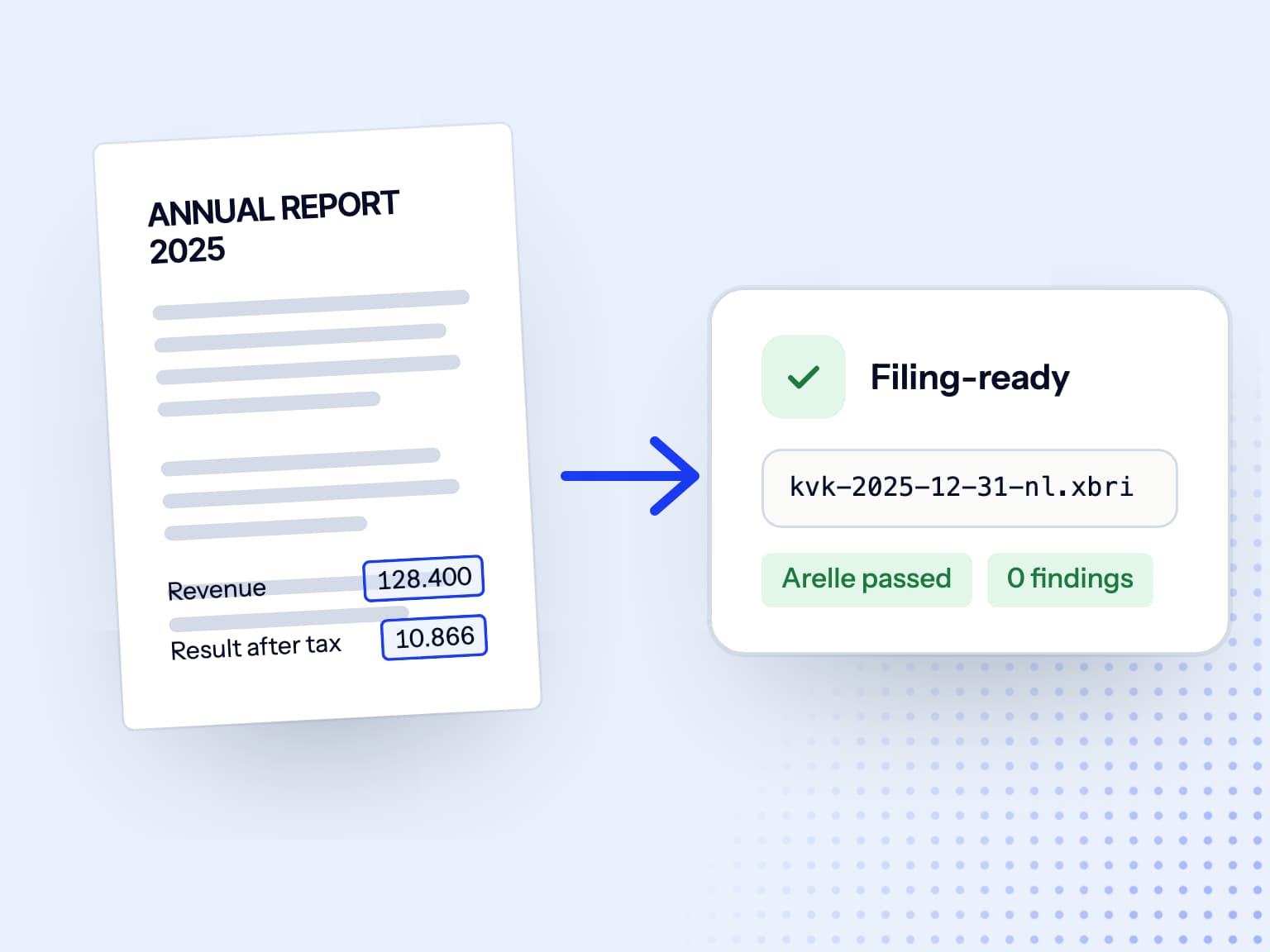
iXBRL solves the central problem of XBRL: the separation between readability and structure. With iXBRL, the XBRL tags are embedded directly in an xHTML document that, to humans, simply looks like a set of annual accounts. Open the file in a browser: you see the layout, the tables and the text. Open the same file in an XBRL processor such as Arelle: you see the tagged financial data.
The result is one file with two faces:
A readable set of annual accounts in xHTML, suitable for publication on a website or as an attachment.
A machine-readable XBRL data layer, suitable for automated processing by regulators, banks, investors and data aggregators.
The RTS of the SBR trade-register domain therefore names iXBRL the recommended format for annual reports in which presentation plays an important role. This mirrors ESEF, where the same principle has applied since its introduction.
Example: one revenue line, two readers
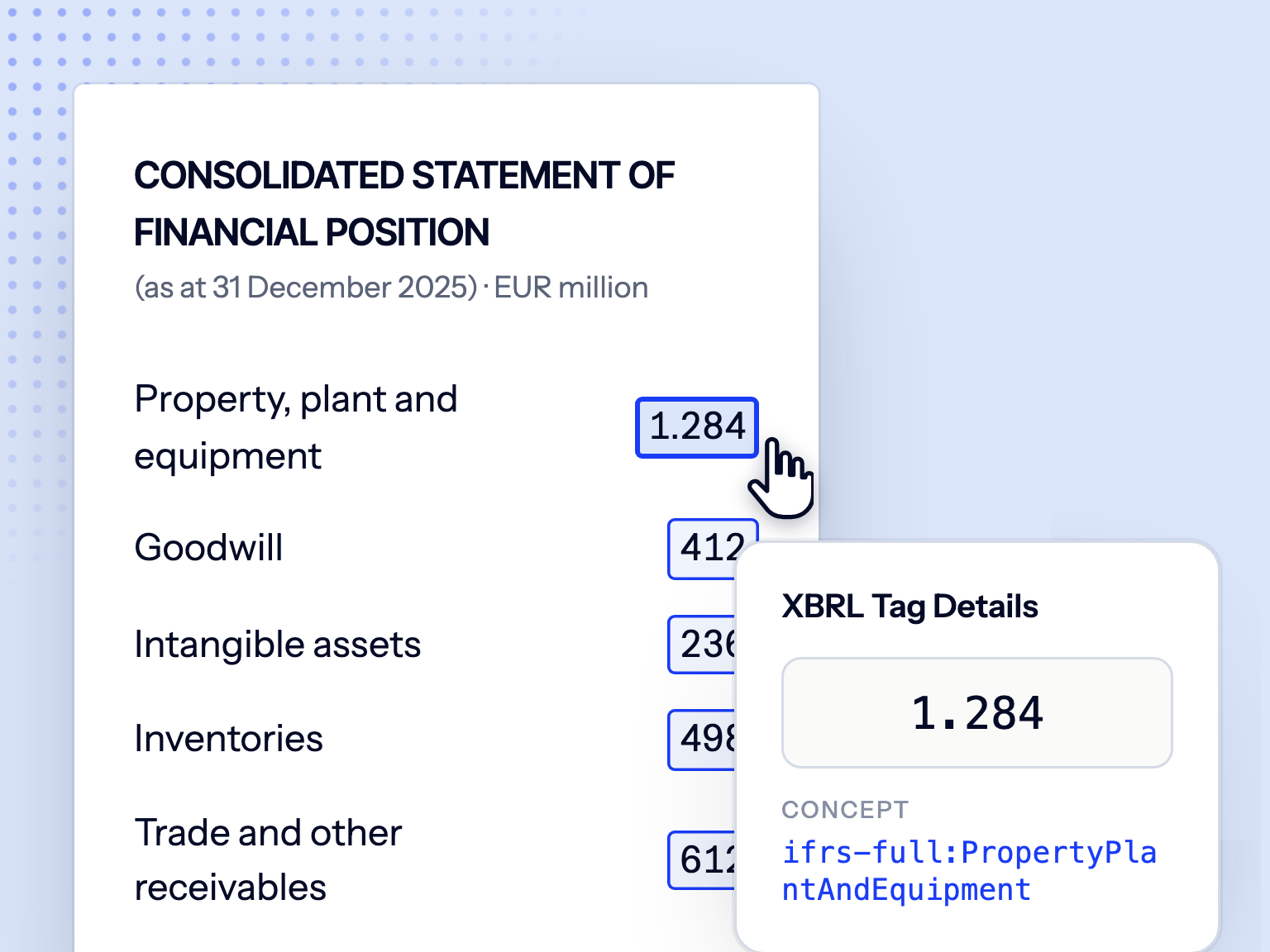
Suppose the profit and loss account shows the line “Net revenue 1,234”, in thousands of euros. A human reader simply sees that number in the table. In the iXBRL file, that same number is wrapped in an invisible tag that tells software four things:
The concept: which taxonomy element belongs to this number, for example the net-revenue element from the Dutch Taxonomy, or ifrs-full:Revenue under ESEF.
The context: which entity and which period the figure relates to, so the current financial year and the comparative figure stay apart.
The unit and the scale: euros, with a scale factor of 3 because the number is presented in thousands. Software therefore reads 1,234,000.
The accuracy: a decimals value of -3 states that the amount is rounded to thousands of euros.
The browser still shows “1,234”, but an XBRL processor reads net revenue of 1,234,000 euros for the reported financial year. Presentation and data remain one whole: no gap can open up between what the reader sees and what the software extracts, as can happen with a standalone PDF next to a separate data file.
XBRL versus iXBRL: the core differences
Feature | XBRL (instance document) | iXBRL (Inline XBRL) |
|---|---|---|
File format | XML | xHTML |
Human-readable | No, requires software | Yes, directly in the browser |
Machine-readable | Yes | Yes |
Number of files | At least 2 (instance + readable rendering) | 1 combined document |
Use at KVK (SBR) | SBR instance, at most 15 MB | Report Package, at most 100 MB; optional format from financial year 2025 |
Use for ESEF (IFRS) | Not applicable | Mandatory for the IFRS consolidated financial statements |
Taxonomy | Dutch Taxonomy (NT) | NT plus an own extension taxonomy (KVK) or the ESEF taxonomy (listed) |
Validation | Arelle, SBR Filing Rules | Arelle, RTS of the SBR trade-register domain or the ESEF Reporting Manual |
Where do you encounter iXBRL in the Netherlands?
It is important to distinguish two strictly separate regimes: KVK filing via SBR and ESEF reporting for listed companies.
KVK filing via SBR
Digital filing via SBR has been mandatory for most legal entities for years: micro and small legal entities since financial year 2016, medium-sized legal entities since financial year 2017. On 18 December 2024 the Decree on electronic filing with the trade register was amended (Staatsblad 2024, 428), removing the last exceptions: for financial years beginning on or after 1 January 2025, large legal entities and medium-sized subsidiaries of large groups must also file digitally via SBR. Filing on paper or in PDF is no longer an option for those financial years.
Size class | Digital filing mandatory from | Permitted format |
|---|---|---|
Micro | Financial year 2016 | XBRL instance or iXBRL Report Package |
Small | Financial year 2016 | XBRL instance or iXBRL Report Package |
Medium-sized | Financial year 2017 | XBRL instance or iXBRL Report Package |
Large | Financial year 2025 | XBRL instance or iXBRL Report Package |
Listed with registered office in the Netherlands | Exempt from SBR; files with the AFM | iXBRL under ESEF |
Since financial year 2025 there is also a format choice: you file either a classic SBR XBRL instance or an iXBRL Report Package. The RTS recommends iXBRL as the new standard; the classic XBRL format remains suitable for annual accounts that fit seamlessly within the fixed framework of the taxonomy, which is mostly the case for micro and small legal entities. Switching earlier voluntarily is possible: KVK has accepted filings in the iXBRL format since February 2025, including for financial years that began before 1 January 2025.
In two cases iXBRL is not a choice but an obligation. Legal entities within the scope of the Corporate Sustainability Reporting Directive (CSRD) must use the European format, because the sustainability statement, as part of the management report, must be prepared in that format and the annual report may not be split across two formats. In addition, legal entities for which no suitable predefined XBRL entry point exists, for example annual accounts on a foreign-GAAP basis or a strongly deviating presentation, must also use iXBRL. Whoever chooses iXBRL additionally prepares an own extension taxonomy, following the ESEF example.
Medium-sized and large legal entities also file an auditor's report with the deposit; read our explanation of when an auditor's report on the annual accounts is mandatory. The report is digitally signed and inseparably linked to the annual accounts via SBR Assurance, and must be filed in the same format as the annual accounts themselves.
ESEF reporting under IFRS (listed companies)
ESEF stands for European Single Electronic Format. It is an ESMA requirement, based on the Transparency Directive, for issuers with securities on EU-regulated markets. The entire annual financial report is prepared in xHTML; where the report contains IFRS consolidated financial statements, those must be tagged with iXBRL. In the Netherlands the AFM supervises compliance. Issuers with their registered office in the Netherlands are therefore exempt from the SBR filing obligation: they submit their ESEF annual report to the AFM.
ESEF uses the ESEF taxonomy, an extension of the IFRS Accounting Taxonomy. The primary financial statements (statement of financial position, statement of profit or loss with other comprehensive income, cash flow statement and statement of changes in equity) are tagged in detail; EU-wide this obligation applies to financial years beginning on or after 1 January 2020, with the Netherlands using the one-off COVID-19 postponement option, so the obligation applied here from financial year 2021. Block tagging of the notes, marking up whole blocks of text with a single tag, is mandatory for financial years beginning on or after 1 January 2022. Own extension elements in the primary statements must be anchored to the core concept with the closest accounting meaning (anchoring). The entity identifies itself with an LEI (ISO 17442), not with a KVK number.
Do not confuse ESEF with KVK filing. ESEF applies exclusively to listed companies and uses the ESEF taxonomy; KVK filing applies to all Dutch legal entities with a publication obligation and uses the Dutch Taxonomy.
Common iXBRL mistakes
An iXBRL file can look perfect in the browser and still contain unusable data. These are the errors validation software and regulators encounter most often:
Wrong scale: an amount in thousands tagged without a scale factor, so software reads 1,234 instead of 1,234,000. Visually nothing is wrong; the data layer is off by a factor of a thousand.
Sign errors: a loss presented in parentheses but tagged as a positive amount. The sign of the structured value must follow the accounting meaning; presentation handles the parentheses.
Too broad a concept: a general taxonomy element chosen while an element with a narrower, better-fitting meaning exists. The rule in both the RTS and the ESEF Reporting Manual is: choose the element with the closest meaning.
Wrong file shape: a plain HTML file instead of xHTML, or loose files instead of a valid Report Package with the required package files.
Missing metadata: mandatory facts such as the KVK number, legal form, size class and reporting period. If those mark-ups are missing, KVK does not process the annual report, which means the filing obligation has not been met.
How is an iXBRL file validated?
The most widely used open-source XBRL processor is Arelle, certified by XBRL International as a validating processor. Arelle checks whether the tags are technically well-formed, whether the concepts used exist in the taxonomy and whether the calculations, such as subtotals, are internally consistent.
For KVK filings, the requirements of the RTS and the Reporting Manual of the SBR trade-register domain apply in addition, plus the general SBR Filing Rules (FR-NL). On sbr-nl.nl you can find example Report Packages (.xbri) per size class for testing software and internal processes.
For ESEF, the ESEF Reporting Manual and the annually updated ESEF taxonomy files from ESMA apply; with the accompanying ESEF Conformance Suite, software vendors and internal teams can test whether their validation applies the rules correctly. Validate the iXBRL file against these rules before it is submitted to the AFM.
Related topics
How do you convert annual accounts to XBRL or iXBRL? A step-by-step explanation of the conversion process, from approved PDF document to validated iXBRL file.
Electronic filing: SBR or iXBRL? When to choose the classic SBR format and when iXBRL is the right choice for your KVK filing.
ESEF reporting and iXBRL for IFRS companies. Everything about the ESEF obligation for listed companies, the ESEF taxonomy, LEI numbers and the role of the AFM.
Frequently asked questions
What is the difference between XBRL and iXBRL?
XBRL (eXtensible Business Reporting Language) is a structured XML format that makes financial data machine-readable, but is not directly readable by humans. iXBRL (Inline XBRL) combines the XBRL tags with a readable xHTML document in a single file. With iXBRL you see normal annual accounts in a browser, while an XBRL processor can simultaneously read the tagged financial data. The main practical difference is that with iXBRL you have one file that meets both requirements, whereas with classic XBRL you need a separate readable rendering alongside the XBRL instance.
What is the meaning of iXBRL?
iXBRL is the abbreviation of inline eXtensible Business Reporting Language. “Inline” refers to the fact that the XBRL tags are embedded (“placed inline”) in an xHTML document, so that human readability and machine readability are combined in a single file.
What is the full name of iXBRL?
The full name is inline eXtensible Business Reporting Language. The abbreviation iXBRL is also written as Inline XBRL; technically it is defined in the Inline XBRL 1.1 specification of XBRL International.
Is it mandatory to file annual accounts electronically?
Yes. Micro and small legal entities have filed digitally since financial year 2016, medium-sized legal entities since financial year 2017 and large legal entities from financial year 2025, under the amended Decree on electronic filing with the trade register. Filing runs via SBR: automated via Digipoort or manually via the KVK upload portal.
Can I still file in the classic XBRL format (SBR instance)?
Yes. From financial year 2025 you choose at KVK between an XBRL instance and an iXBRL Report Package. Only legal entities within the scope of the CSRD and legal entities without a suitable predefined XBRL entry point must use iXBRL. The RTS does recommend iXBRL as the new standard.
What file format does an iXBRL file have?
An iXBRL file is an xHTML file (.xhtml) with embedded XBRL tags. At KVK you file it as a Report Package: a ZIP archive (also known as .xbri) containing the iXBRL document, the extension taxonomy and the accompanying package files, with a maximum of 100 MB.
Do I need to use the same taxonomy for ESEF as for KVK?
No. KVK filing uses the Dutch Taxonomy, managed by Logius, supplemented with an own extension taxonomy under the iXBRL format. ESEF uses ESMA's ESEF taxonomy, an extension of the IFRS Accounting Taxonomy. The two regimes and taxonomies are separate.
Doc2iXBRL for iXBRL conversion and validation
Doc2iXBRL is a platform for accountants and finance teams who need to convert approved annual accounts (PDF or Word) into a valid iXBRL file. The software automatically suggests XBRL tag mappings based on the Dutch Taxonomy or the ESEF taxonomy, while the reviewer remains fully in control of the final tags. Built-in Arelle validation and proprietary pre-filing checks verify the iXBRL file before it is submitted, without guaranteeing a KVK or ESMA acceptance outcome.
Request a demoSources
sbr-nl.nl: Expansion of electronic filing with the trade register, with the RTS, the Reporting Manual and example Report Packages per size class.
kvk.nl: Filing with SBR, with the requirements per size class and the upload portal.
officielebekendmakingen.nl: Decree of 18 December 2024 (Staatsblad 2024, 428) extending electronic filing to large legal entities.
esma.europa.eu: Electronic reporting (ESEF), with the RTS on ESEF, the ESEF Reporting Manual and the taxonomy files.
logius.nl: XBRL and the management of the Dutch Taxonomy by the XBRL Expertise Centre.