

For financial years starting on or after 1 January 2024, higher size criteria apply: the thresholds for balance sheet total and net turnover have been raised by approximately 25% (Implementation Decree raising the thresholds, Stb. 2024, 52). Your company falls into a size category when it meets at least 2 of the 3 criteria on two consecutive balance sheet dates. That category, micro, small, medium-sized or large, determines which documents you file with KVK, whether an auditor's report (accountantsverklaring) is required, and in which format you file electronically. The raised thresholds continue to apply to financial years starting in 2025 and 2026.
Key facts
Applies to: financial years starting on or after 1 January 2024 (Stb. 2024, 52). Earlier application to financial years starting on or after 1 January 2023 was permitted, but not mandatory.
The three criteria: balance sheet total, net turnover and the average number of employees over the financial year.
Classification rule: meet at least 2 of the 3 criteria on two consecutive balance sheet dates. For the first and second financial year, the position on the balance sheet date of the first financial year is decisive (art. 2:398(1) of the Dutch Civil Code, BW).
Legal basis: art. 2:395a (micro), 2:396 (small) and 2:397 BW (medium-sized). Whoever exceeds the art. 2:397 limits is large.
Consequence: the category determines the layout of the annual accounts (jaarrekening), the publication obligation, the audit obligation and the filing format.
Regulator / portal: wetten.overheid.nl (Book 2, Title 9 BW); filing with KVK, at the latest 12 months after the end of the financial year.
What are the size criteria?
The size criteria (groottecriteria) are the statutory thresholds that determine which size category a legal entity falls into for the annual accounts. They are measured against three quantities: the balance sheet total, the net turnover and the average number of employees over the financial year. The larger the company, the more extensive the reporting and publication requirements.
The micro, small and medium-sized regimes are laid down in art. 2:395a, 2:396 and 2:397 BW respectively; a legal entity that exceeds the art. 2:397 limits is large. For financial years starting from 1 January 2024, the thresholds for balance sheet total and net turnover were raised by approximately 25% (Stb. 2024, 52), as an inflation correction over the period 2013 through March 2023. As a result, more companies fall into a lighter regime. The amounts have not been changed since and therefore also apply to financial years starting in 2025 or 2026 (statute in force, consulted July 2026).
The 2024-2026 size criteria in a table
The limits below apply to financial years starting on or after 1 January 2024, including financial years 2025 and 2026. A company falls into a category when it meets at least 2 of the 3 criteria on two consecutive balance sheet dates.
Regime | Balance sheet total | Net turnover | Avg. employees |
|---|---|---|---|
Micro (art. 2:395a) | up to and including 450,000 euro | up to and including 900,000 euro | fewer than 10 |
Small (art. 2:396) | up to and including 7.5 million euro | up to and including 15 million euro | fewer than 50 |
Medium-sized (art. 2:397) | up to and including 25 million euro | up to and including 50 million euro | fewer than 250 |
Large (above art. 2:397) | more than 25 million euro | more than 50 million euro | 250 or more |
For comparison, the old thresholds (for financial years starting before 1 January 2024, unless the new amounts were applied early on a voluntary basis):
Regime | Balance sheet total (old) | Net turnover (old) |
|---|---|---|
Micro | up to and including 350,000 euro | up to and including 700,000 euro |
Small | up to and including 6 million euro | up to and including 12 million euro |
Medium-sized | up to and including 20 million euro | up to and including 40 million euro |
Large | more than 20 million euro | more than 40 million euro |
The criterion for the average number of employees has not changed. For micro entities, the increase is effectively 28.6%: the European Commission rounded the balance sheet threshold up to the next 25,000 euro and kept the ratio whereby the net turnover threshold is double the balance sheet threshold. Companies were moreover allowed to apply the raised thresholds voluntarily to financial years starting on or after 1 January 2023, including for the comparative figures. In case of doubt about a specific financial year, the statutory text of art. 2:395a through 2:398 BW on wetten.overheid.nl is decisive.
The two-year rule: two consecutive balance sheet dates
The classification into a category only applies once at least 2 of the 3 criteria are met on two consecutive balance sheet dates. These do not have to be the same two criteria on both dates. This waiting period prevents the regime from flipping immediately when a company exceeds a threshold in one exceptional year: you look at the balance sheet date of the financial year itself and that of the preceding financial year.
A separate rule applies to a newly incorporated legal entity: for the first and second financial year, the position on the balance sheet date of the first financial year is decisive (art. 2:398(1) BW). A company that exceeds the medium-sized limits in its first financial year can therefore be subject to a statutory audit from that first financial year onwards.
Worked example
A BV has a balance sheet total of 8.2 million euro, net turnover of 14.1 million euro and an average of 38 employees on 31 December 2024. On 31 December 2025 these are 8.6 million euro, 14.8 million euro and 44 employees. The balance sheet total exceeds the small-regime limit of 7.5 million euro on both dates, but net turnover stays below 15 million euro and the number of employees below 50. On both balance sheet dates the BV therefore meets 2 of the 3 criteria for small: for financial year 2025 it is a small legal entity, files an abridged balance sheet with notes, and needs no auditor's report.
If net turnover also exceeded 15 million euro on both dates, the BV would meet only 1 of the 3 small-regime criteria and would become medium-sized, triggering the audit obligation and the management report.
Groups, IFRS and stock exchange listing: three pitfalls
Group heads count on a consolidated basis. For the size test, the assets, net turnover and employees of group companies that would have to be included in the consolidation count along (art. 2:396(2) and 2:397(2) BW). A small holding company with sizeable subsidiaries is therefore often medium-sized or large after all. This does not apply when the intermediate-holding exemption of art. 2:408 BW is used.
IFRS reporters are always large. If the annual accounts are prepared in accordance with IFRS as adopted by the EU, the exemption section of Title 9 does not apply and the annual reporting is treated as that of a large legal entity, regardless of actual size (RTS of the SBR domain Handelsregister).
Listed companies do not file with KVK via SBR. Issuers within the meaning of art. 5:25o of the Dutch Financial Supervision Act (Wft) are exempt from the SBR filing obligation; they file their annual reporting in the European ESEF format with the AFM (Stb. 2024, 428).
What does each regime mean for the filing?
The size category directly determines which documents you must make public and whether an auditor's report is required.
Regime | To be filed with KVK | Auditor's report | Management report |
|---|---|---|---|
Micro | Limited balance sheet; profit and loss account not public | Not required | Not required |
Small | Abridged balance sheet with notes; profit and loss account not public | Not required | Not required |
Medium-sized | Somewhat simplified balance sheet, simplified profit and loss account and extensive notes | Required | Required |
Large | Full balance sheet, full profit and loss account and extensive notes | Required | Required |
Concretely: a micro entity files only a limited balance sheet and a small entity an abridged balance sheet with notes; neither makes its profit and loss account public and neither needs an auditor's report. Medium-sized and large entities additionally file the management report (bestuursverslag) and the auditor's report. That report is the statutory audit opinion of art. 2:393 BW, not a compilation or review report. When exactly an audit is mandatory is explained in auditor's report for the annual accounts: when is it mandatory?.
The filing deadline depends on the legal form and the adoption of the annual accounts, but the annual accounts must in any case be filed with KVK within 12 months after the end of the financial year.
Consequences for electronic filing (SBR and iXBRL)
The size category also determines since when electronic filing is mandatory. Micro and small entities have filed digitally via SBR since financial year 2016. Medium-sized entities have been required to file electronically via SBR since financial year 2017, including the digital audit opinion with the auditor's electronic signature. For large entities the obligation applies, as the final step, to financial years starting on or after 1 January 2025 (Stb. 2024, 428); for earlier financial years a large legal entity could still file on paper or in PDF.
Since financial year 2024 there has also been a choice of format when filing electronically: the familiar SBR XBRL instance format or the European iXBRL format (XHTML), filed as a Report Package via SBR software (Digipoort) or the KVK self-filing portal. Financial year 2024 served as a voluntary transition year; from financial year 2025 everyone files electronically and the choice remains. The choice is independent of the accounting framework: an IFRS annual report may also be filed in XBRL or iXBRL. iXBRL is, however, mandatory when you include a sustainability report in the management report (CSRD), when you use entity-specific line items or adapt the layout and presentation of the annual accounts, and when no suitable predefined XBRL entry point exists, such as under a foreign accounting framework. The auditor's report must be filed in the same format as the annual accounts. Read more about this choice in electronic filing via SBR or iXBRL: what is mandatory?.
Frequently asked questions
What are the size criteria for the annual accounts in 2024, 2025 and 2026? For financial years from 1 January 2024, raised thresholds apply (Stb. 2024, 52). Micro: balance sheet total up to and including 450,000 euro and net turnover up to and including 900,000 euro. Small: up to and including 7.5 million euro balance sheet total and 15 million euro net turnover. Medium-sized: up to and including 25 million euro balance sheet total and 50 million euro net turnover. Large is above that. The employee criterion (fewer than 10, 50 or 250) is unchanged. These amounts also apply to financial years 2025 and 2026.
By how much were the size criteria raised? The thresholds for balance sheet total and net turnover were raised by approximately 25% as an inflation correction; for micro entities the increase comes to 28.6% due to rounding. The criterion for the average number of employees has not changed. Voluntary application to financial years starting on or after 1 January 2023 was permitted.
How many criteria do I need to meet to fall into a category? You fall into a category when you meet at least 2 of the 3 criteria (balance sheet total, net turnover, average number of employees) on two consecutive balance sheet dates; these need not be the same two criteria. For the first and second financial year of a new legal entity, the balance sheet date of the first financial year is decisive (art. 2:398(1) BW).
Does a small or micro enterprise need an auditor's report? No. Micro and small legal entities are exempt from the statutory audit. A micro entity files a limited balance sheet, a small entity an abridged balance sheet with notes; the profit and loss account remains non-public for both. An audit opinion (art. 2:393 BW) is required for medium-sized and large legal entities. Mind the group test: figures of group companies that would have to be consolidated count along.
What must a large company file? A large legal entity files the full balance sheet, full profit and loss account and extensive notes, together with the management report and the auditor's report. For financial years starting on or after 1 January 2025 this must be done electronically via SBR; the auditor's report is filed in the same format as the annual accounts.
In which format should I file the annual accounts? Since financial year 2024 you can choose, when filing electronically, between the SBR XBRL instance format and the European iXBRL format (XHTML), regardless of whether you apply Dutch GAAP or IFRS. iXBRL is mandatory for a CSRD sustainability report, for entity-specific line items or an adapted presentation, and when no suitable XBRL entry point exists (such as under a foreign framework). Read more in filing the annual accounts digitally in iXBRL.
Doc2iXBRL and the size criteria
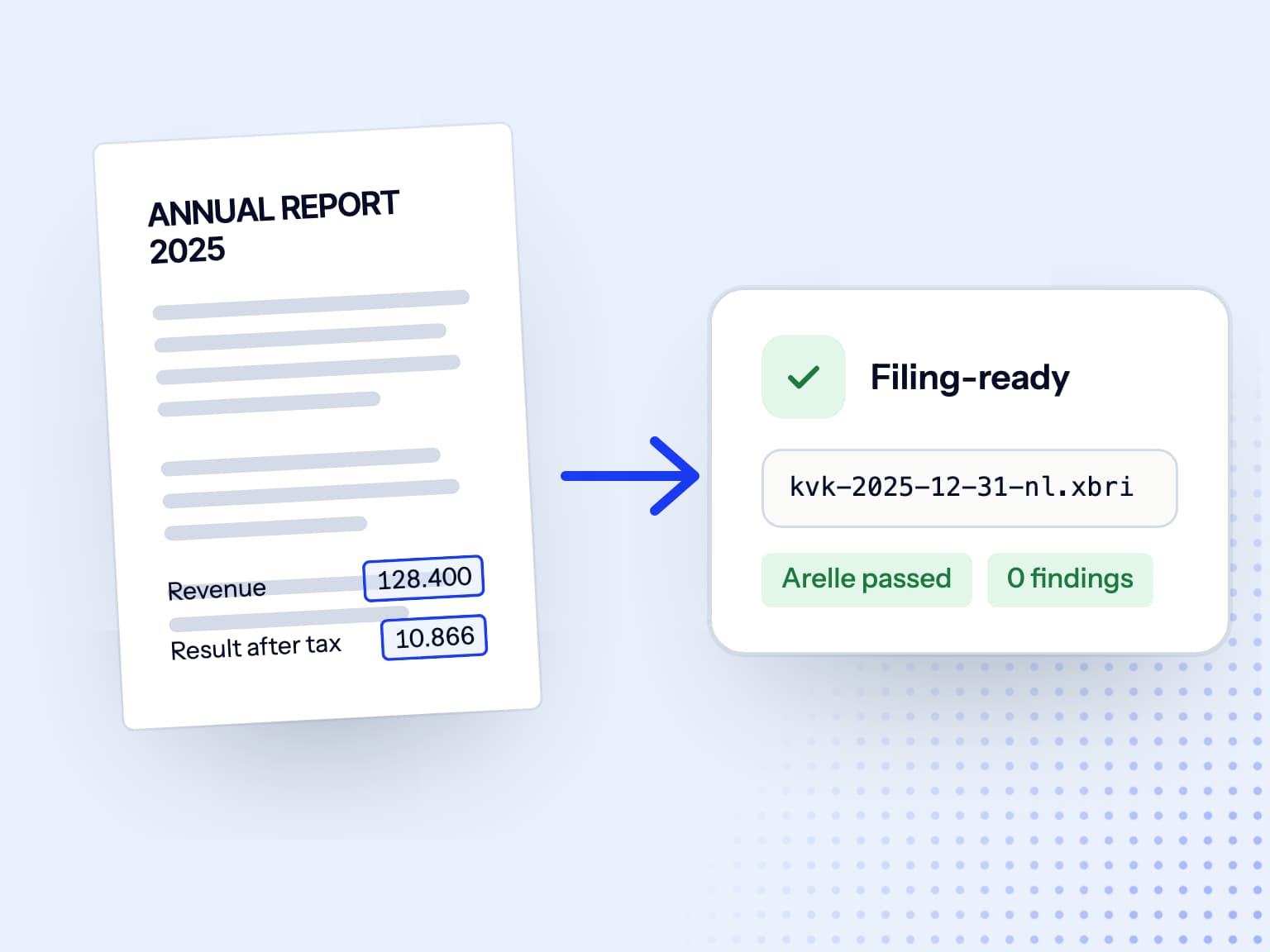
Once the size category is settled, the practical question follows: the right documents in the right format, through the right SBR channel, validated without errors. Doc2iXBRL converts your annual accounts (PDF or DOCX) into compliant iXBRL, maps the concepts with confidence scores and validates upfront with the Arelle processor plus its own pre-filing checks, while the reviewer stays in control. No blind autopilot, no guarantee of a KVK outcome, but less manual work and fewer surprises at submission.
Request a demo