

Filing your annual accounts (jaarrekening) electronically with the Dutch Chamber of Commerce (KvK) is a legal requirement, introduced in phases per size class: micro and small since financial year 2016, medium-sized since financial year 2017 and large from financial year 2025. You file via Standard Business Reporting (SBR) in one of two formats: XBRL (SBR Instance) or iXBRL (SBR Report Package). If you report under Dutch accounting rules (NL GAAP) you may choose; for annual accounts under IFRS or for a sustainability report, iXBRL is mandatory.
Key facts
Who it applies to: every legal entity that must file annual accounts with the KvK, classified into the size classes micro, small, medium-sized and large.
What is mandatory: electronic filing via SBR. For the large size class the obligation applies to financial years beginning on or after 1 January 2025; the Decree on electronic filing business register (Besluit elektronische deponering handelsregister) was amended on 18 December 2024 to that effect.
Two formats: XBRL (SBR Instance) or iXBRL (SBR Report Package). Voluntary filing in iXBRL was already possible for financial year 2024; from financial year 2025 the format choice is the standing regime.
iXBRL mandatory: for annual accounts under IFRS, for a sustainability report (ESRS) in the management report, and for entity-specific line items or a custom presentation of the financial statements.
Auditor's report: required for medium-sized and large entities; it is attached digitally (SBR Assurance) and must be filed in the same format as the annual accounts.
Legal basis: art. 2:394 of the Dutch Civil Code (the filing obligation) and the Decree on electronic filing business register. The size regimes are defined in art. 2:395a (micro), 2:396 (small) and 2:397 (medium-sized) of the Dutch Civil Code; large is any legal entity that exceeds the thresholds of art. 2:397.
What is electronic filing via SBR?
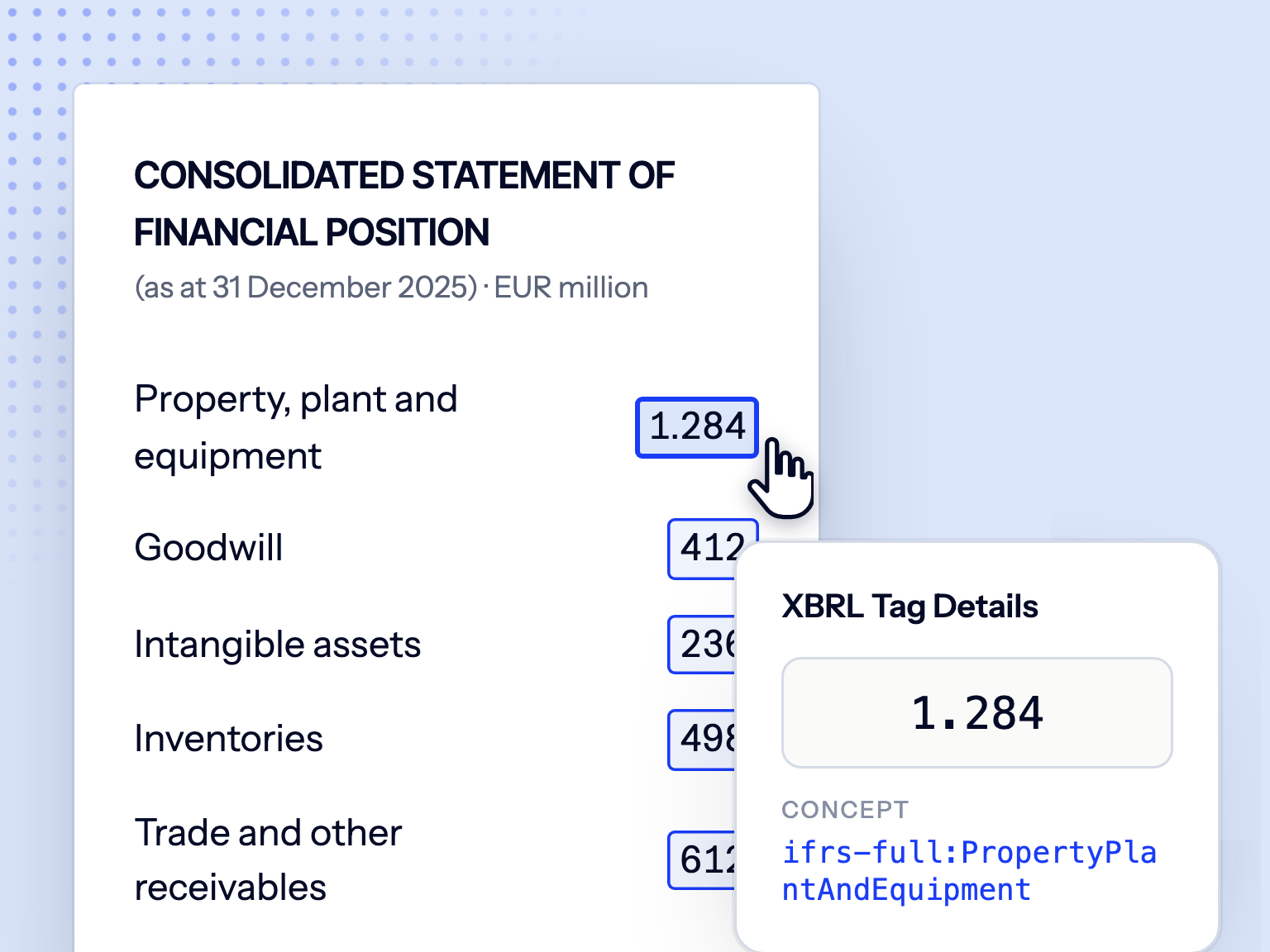
SBR (Standard Business Reporting) is the Dutch standard for submitting annual documents to the KvK in a digital, structured form. The financial data is tagged according to the Dutch Taxonomy (Nederlandse Taxonomie, NT), so the KvK can process it automatically. Submission runs through Digipoort, the government gateway operated by Logius. Our explainer on what SBR is and how filing via SBR works covers how the standard works technically.
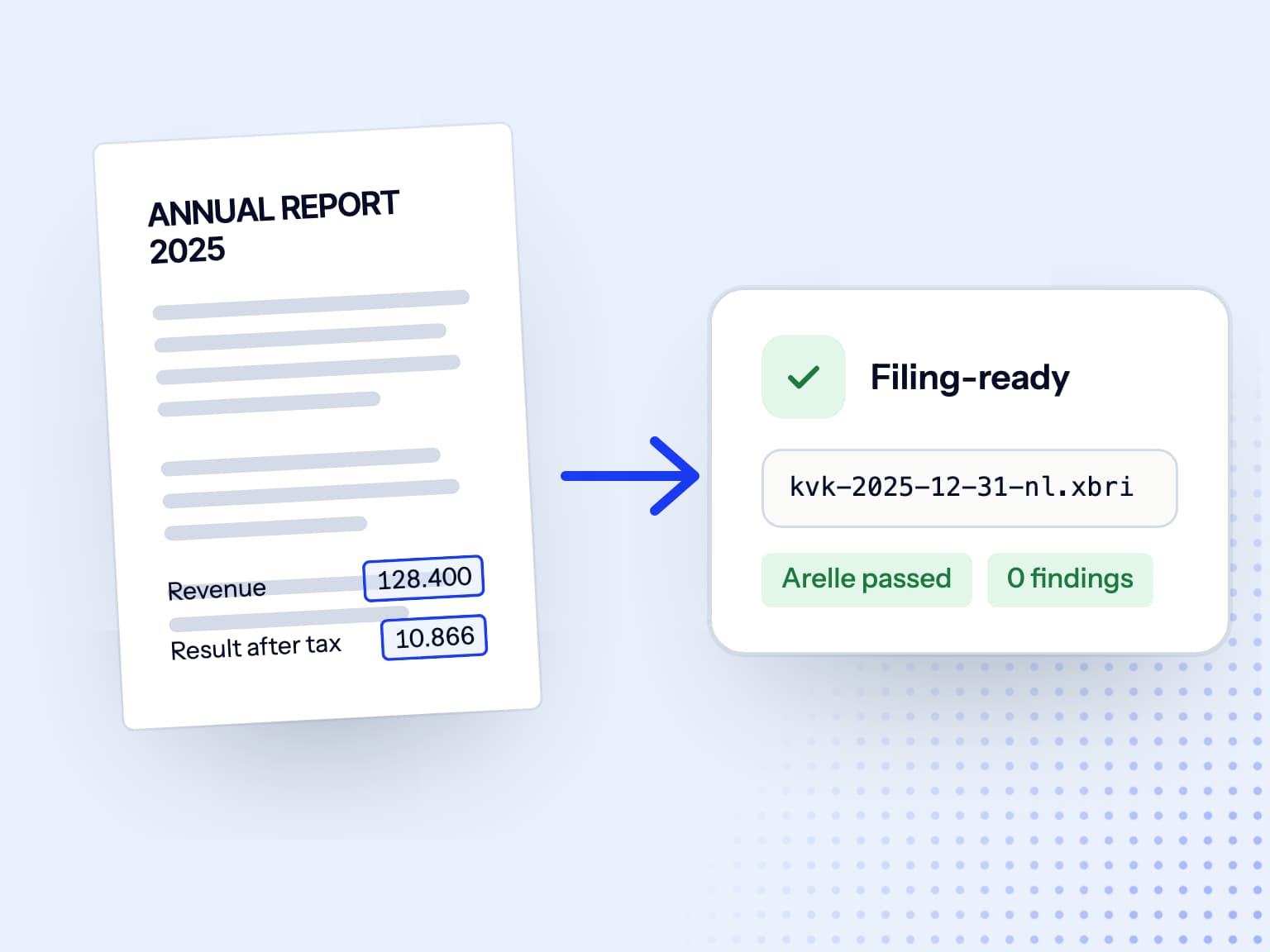
iXBRL (Inline XBRL) is the European reporting format in XHTML, in which a human-readable document and machine-readable XBRL tags are combined in a single file. The same file is therefore readable by both people and machines, without separate documents. At the KvK, a filing in this format is called an SBR Report Package. Also read our article on what iXBRL is and how it differs from XBRL.
The size classes determine not only what you must disclose, but also since when electronic filing is mandatory and whether an auditor's report must be included. The monetary thresholds were raised by approximately 25% for financial years beginning on or after 1 January 2024 (Staatsblad 2024, 52): micro up to a balance sheet total of EUR 450,000 and net turnover of EUR 900,000, small up to EUR 7.5 million and EUR 15 million respectively, medium-sized up to EUR 25 million and EUR 50 million respectively; entities could opt to apply the new thresholds to financial year 2023 already. You will find all thresholds and the employee criteria in our overview of the size criteria for the annual accounts from financial year 2024.
Obligation per size class: the overview
It comes down to two questions: since which financial year does the electronic filing obligation apply to your size class, and in which format do you file? The table below lists the obligation per class, plus whether an auditor's report is required.
Size class | Legal basis | Electronic (SBR) mandatory since | Auditor's report |
|---|---|---|---|
Micro | art. 2:395a Dutch Civil Code | Financial year 2016 | Not required |
Small | art. 2:396 Dutch Civil Code | Financial year 2016 | Not required |
Medium-sized | art. 2:397 Dutch Civil Code | Financial year 2017 | Required, digitally via SBR Assurance |
Large | above the thresholds of art. 2:397 Dutch Civil Code | Financial year 2025 | Required, in the same format as the annual accounts |
For large legal entities (and their affiliated medium-sized subsidiaries), filing on paper was previously permitted. The Decree on electronic filing business register was amended on 18 December 2024: the electronic obligation applies to financial years beginning on or after 1 January 2025. In practice, a large legal entity therefore files electronically from 2026 onwards for financial year 2025. For financial years up to and including 2024, filing in PDF was still permitted in certain group situations (a parent company in another EU Member State or outside the EU).
In practical terms: micro and small legal entities can prepare and file their annual accounts in the KvK's Zelf Deponeren (self-filing) portal, or file with financial software via SBR. Medium-sized and large legal entities can upload the adopted annual accounts in that same portal or file via SBR software; that software requires a PKIoverheid certificate. Note: for the large size class, the XBRL format (SBR Instance) is not yet available via the portal, only via SBR software; iXBRL works via both routes.
The format choice: XBRL (SBR Instance) or iXBRL (SBR Report Package)
XBRL (SBR Instance): a structured XBRL file based on a predefined entry point from the Dutch Taxonomy. Standardised and proven, but the annual accounts must conform to that fixed framework.
iXBRL (SBR Report Package): the European Inline XBRL format, in which the human-readable annual report and the XBRL tags are combined in a single XHTML file, packaged as a report package. More flexible, suitable for a custom presentation and for sustainability information; it does require an extension taxonomy of your own.
Which format fits your situation? The Regulatory Technical Standard (RTS) of the SBR domain Business Register recommends iXBRL as the standard for annual reports, because presentation matters there. The choice is not always free, however:
Your situation | Format |
|---|---|
Annual accounts under NL GAAP, standard layout | Free choice: XBRL or iXBRL |
Annual accounts (consolidated and/or company-only) under IFRS | iXBRL mandatory, including for IFRS consolidated financial statements combined with NL GAAP company financial statements |
Sustainability report (ESRS) in the management report | iXBRL mandatory |
Entity-specific line items or a custom presentation of the financial statements | iXBRL required |
No suitable predefined XBRL entry point available | iXBRL |
Listed and subject to ESEF | The ESEF report can be filed with the KvK for financial years beginning on or after 1 January 2026 |
If you choose iXBRL under NL GAAP or IFRS, an extension taxonomy of your own (entity-specific disclosures) is mandatory: a small taxonomy package containing your own line items, presentation order, calculation rules and dimensions. Its technical requirements align as much as possible with those of ESEF, the format for listed companies.
Practical requirements for an iXBRL filing
The SBR Report Package must not exceed 100 MB and is delivered via Digipoort (automatically, from software) or via the upload portal on the KvK website.
Only one adopted set of annual accounts can be filed per legal entity per financial year; so check the KvK number carefully.
Each set of core taxonomies remains valid for filings for three years. For financial year 2025, both the financial year 2024 taxonomy set and the 2025 set can be used.
Validate before submission against the SBR Filing Rules (FR-NL) and the KvK-specific rules; Arelle is the widely used open-source validator. A file that fails validation is rejected at Digipoort and must be resubmitted.
On sustainability: European sustainability legislation (CSRD) is still in flux due to the European Commission's Omnibus simplification package. The expectation in the RTS 2025 is that sustainability reports will be mandated in XHTML with ESRS taxonomy markups. Anyone already including a sustainability report under the ESRS in the management report must therefore choose the iXBRL format.
The auditor's report and SBR Assurance
For medium-sized and large legal entities, the auditor's report (controleverklaring) is part of the filing (art. 2:393 Dutch Civil Code). Medium-sized companies have attached it digitally via SBR Assurance since financial year 2017. For large legal entities there is an additional rule: the auditor's report must be filed in the same format as the annual accounts; with an SBR Report Package it forms part of the package.
A common pitfall when converting an existing annual report: NBA Alert 50 (June 2025) states that including the original auditor's report in an SBR Report Package after a technical conversion counts as a new publication of that report. This requires the auditor's written consent, while the technical conversion itself falls outside the statutory audit of art. 2:393 Dutch Civil Code. Discuss this scenario with your auditor in advance, so that obtaining consent does not cause delays right before the deadline.
Deadlines: when must the annual accounts be filed?
Once adopted, the annual accounts must be filed with the KvK within eight days. In addition, an absolute limit applies to all legal forms: the annual accounts must be filed within twelve months after the end of the financial year. For a Dutch bv this means: the board prepares the annual accounts within five months after the end of the financial year, the general meeting can extend this by a maximum of five months, followed by adoption and filing. Worked example: if your financial year equals calendar year 2025, the annual accounts must be with the KvK by 31 December 2026 at the latest — adopted or, if adoption is not achieved in time, as prepared but not yet adopted annual accounts.
Frequently asked questions
Since when has electronic filing via SBR been mandatory? It differs per size class. For micro and small entities the obligation has applied since financial year 2016, for medium-sized entities since financial year 2017, and for large entities from financial year 2025. Paper filing was previously permitted for large legal entities; the amendment of the Decree on electronic filing business register removes that exception for financial years beginning on or after 1 January 2025.
When is iXBRL mandatory instead of XBRL? For annual accounts under IFRS, iXBRL is mandatory — including when only the consolidated financial statements follow IFRS and the company financial statements follow NL GAAP. iXBRL is also mandatory for a sustainability report (ESRS) in the management report, and required for entity-specific line items, a custom presentation, or when no suitable XBRL entry point exists. Only for NL GAAP annual accounts in the standard layout is the choice free.
Do I need to include an auditor's report with the annual accounts? No auditor's report is required for micro and small entities. For medium-sized and large entities it is required: the report is attached digitally (SBR Assurance) and must be filed in the same format as the annual accounts. If an existing annual report is technically converted into an SBR Report Package, take into account the auditor's written consent under NBA Alert 50.
What is the difference between SBR (XBRL instance) and iXBRL? An XBRL instance (SBR Instance) is a purely machine-readable file based on a fixed entry point from the Dutch Taxonomy. iXBRL (SBR Report Package) is an XHTML file in which the readable annual report and the XBRL tags are combined: one file for both people and machines, with an extension taxonomy of your own. Both are valid electronic filing routes at the KvK, except where iXBRL is mandatory.
Can a large legal entity still file on paper? No, not from financial year 2025 onwards. For financial years up to and including 2024, filing in PDF was still permitted in certain group situations. If electronic filing genuinely proves impossible, contact the KvK first; an exemption route exists.
Does my size class determine the format? No, not directly. The size class determines since when the electronic obligation applies, what you must disclose and whether an auditor's report is required. The format choice (XBRL or iXBRL) is separate from this and is driven by your reporting framework (NL GAAP or IFRS), any sustainability report, and the degree of customisation in your annual accounts.
Doc2iXBRL for electronic filing
Whether you file in XBRL (SBR Instance) or in iXBRL (SBR Report Package): the right format, a valid extension taxonomy and validation before submission determine whether the delivery at Digipoort goes smoothly. Doc2iXBRL converts approved PDF or Word annual reports into validated XBRL or iXBRL files, validates against the SBR Filing Rules via Arelle plus its own pre-filing checks, and keeps the reviewer fully in control, without guaranteeing a KvK outcome. How to get from an approved PDF annual report to a valid file is covered in our article on converting annual accounts to XBRL or iXBRL. Would you like to see how this works for your size class and reporting framework?
Request a demoSources
Netherlands Chamber of Commerce (KvK), Filing with SBR: https://www.kvk.nl/deponeren/deponeren-met-sbr/
Netherlands Chamber of Commerce (KvK), Filing annual accounts, business class large: https://www.kvk.nl/deponeren/jaarrekening-deponeren-bedrijfsklasse-groot/
Netherlands Chamber of Commerce (KvK), Final deadline for filing annual accounts: https://www.kvk.nl/deponeren/uiterste-termijn-deponeren-jaarrekening/
SBR Nederland, Expansion of electronic filing business register: https://www.sbr-nl.nl/sbr-domeinen/handelsregister/uitbreiding-elektronische-deponering-handelsregister
SBR Nederland, Regulatory Technical Standard (RTS) 2025 SBR domain Business Register: https://www.sbr-nl.nl/sites/default/files/2025-07/20250716_RTS_2025_EN_SBR-domein_Handelsregister.pdf
Staatsblad 2024, 52, Implementation Decree raising the size thresholds: https://zoek.officielebekendmakingen.nl/stb-2024-52.html
NBA Alert 50, SBR Report Package: https://www.nba.nl/wet--en-regelgeving/alerts/nba-alert-50/